I remember breathing in that crisp air like yesterday, the blushed face that greeted me in the mirror every day, the kind flower lady on the Dal who let me have a whole three extra flowers than what I paid for, and I remember the nervousness that coursed through my body as I sat by the sides of the Lidder and listened to my grandmother narrate stories of how only those children who would not run off here and there and be “good”, would be blessed if they threw a coin into it. I remember myself so clearly, listening with the solemn wonder of a child who believed the river was watching.
But most vividly, I remember careening down the slopes of Baisaran as my friends yelled “ice” and “water.” And for the longest time, I preserved these moments- too cherished, and too distant to ever be confronted by grief.
Until now.
As I sit here in the polluted national capital, trying to make sense of the images, headlines, and eyewitness accounts emerging from Pahalgam, a place I remember for the utmost pristine air and unspoilt beauty, I struggle to comprehend how somewhere so beautiful could be touched by something so brutal. I feel gutted. There were Kaluchak, Pampore, Uri, Pulwama, Reasi before- names I had tucked away in some far-off corner of the mind, as though distance could make them easier to bear.
I, like most, chose never to imagine. Because imagining meant fearing for every friend, soldier, or stranger you’d once met who called the valley home. But this time, there is no need for imagination. It is Pahalgam. A place I remember as fresh as snow on a January morning. What do I do with that memory now?
Pahalgam, it is no longer just a word soaked in nostalgia. The death toll at this hour is 28- including 2 foreign nationals and a newly-married naval officer. Shot, in front of their families, because they were Hindu. And that sentence alone feels like the most fatal rupture out of all I could scan. One that we thought we had healed from after Mumbai. After so many others.
It feels like 26/11 has returned, but this time it came for our holidays, our memories. For the ordinary lives we imagine ourselves entitled to live without fear. I desperately want to blame. And yet, I cannot allow my grief to become an excuse to condemn an entire faith. The deliberate targeting of people because they are Hindu must be named for what it is, without allowing those who commit such violence to speak for millions who share a religion with them.
I think of the people I know who celebrate Eid with enough sevaiyaan to feed half the world, who make room at their tables and in their homes, who have never asked me to prove that I belong before offering me something to eat. I cannot reconcile their kindness with the hatred committed in the name of a faith they share. I cannot believe that the people who taught me the meaning of generosity and the people who carried out this violence could be made into one and the same thing. Perhaps that is precisely why I refuse to let the perpetrators define a faith I have known only through the ever-smiling people who practise it.
I used to read only one genre with real intent- my father’s hoard of terror literature. Out of fear for our safety while we lived in remote cantonments and stretches in the region. Out of needing to understand why we could only go out with the QRT when we did. And why we had to undergo those emergency drills at my school after Peshawar. As a learning outcome, I still scan for hiding places at every new residence. And I always thought of this as a habit I had acquired randomly, while never having to consider how much of a childhood it takes to learn it until today.
Because it could have been you.
It could have been me.
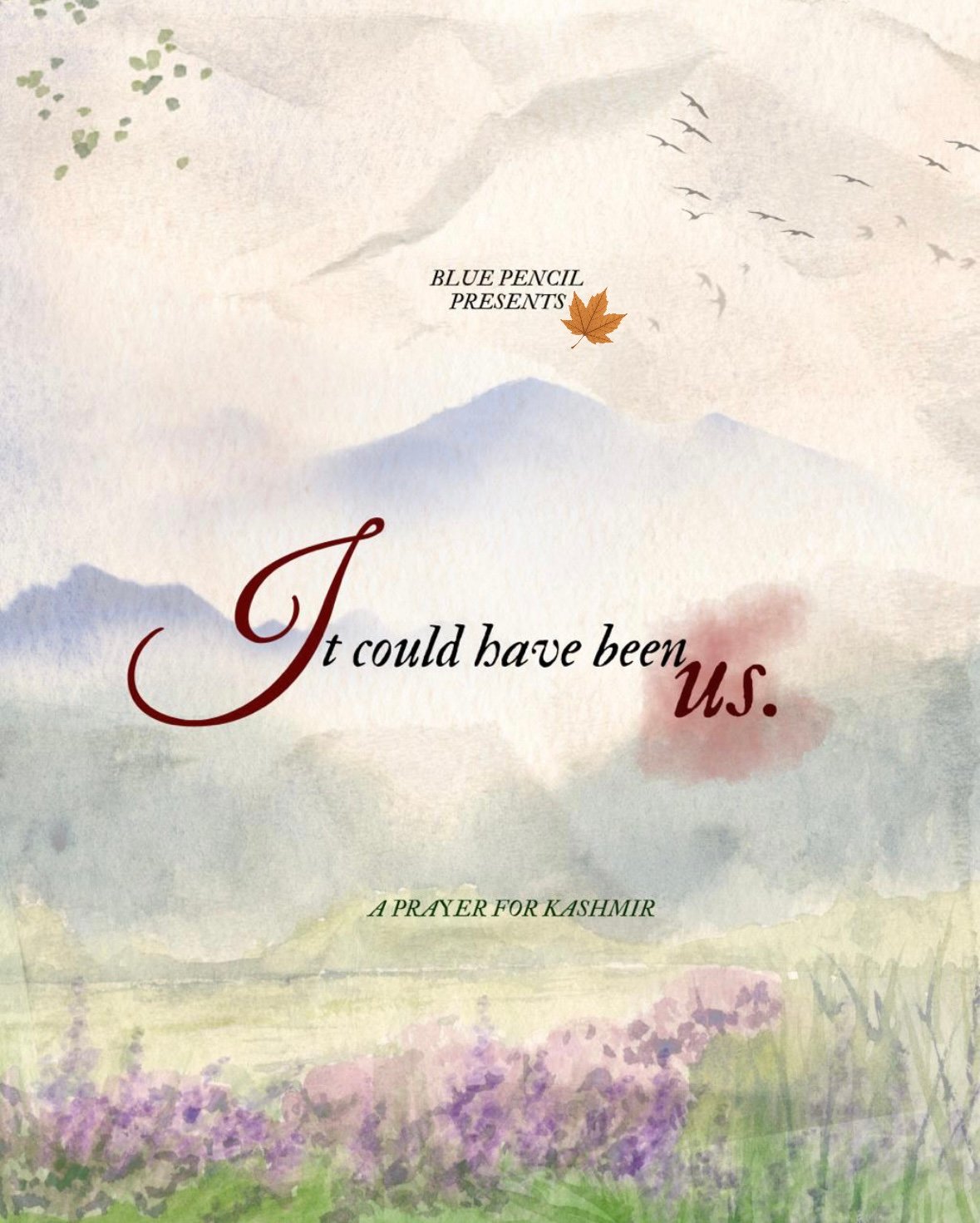
It could have been us.
We often pray for peace in Kashmir like it’s some distant fantasy. But how do you even pray when the snowy landscapes from your postcards have turned into shrouds?
Maybe this article, these words, are my prayer.
A prayer for the flower lady who gave me three extra blooms.
A prayer for the officer who never made it home.
A prayer for the bus driver who just wanted to keep his passengers safe.
A prayer for those who died in Kaluchak, Pampore, Uri, Pulwama, Reasi, and Pahalgam- not just in the attacks, but in their prevention, their aftermath, their echoes.
A prayer for those who live with fear tucked into their coat pockets, right beside their faith.
I think of my grandmother by the Lidder river, telling me that the water blessed good children. I think of the child I was, sitting beside it, believing that some things were sacred enough to keep us safe. I wonder what I would tell that child now. That the river still flows? That the flowers still bloom? That the mountains are still beautiful, even when the people beneath them are afraid?
I do not know.
I only know that somewhere in the world, another child is sitting beside a river, or running down a slope, or begging for one more flower, believing as I once did, that the world is kinder than it is.
May they be allowed to keep believing for a little longer.
May we never become used to this.
May we never stop grieving.
May we remember, even when it hurts, because forgetting is how the unthinkable begins to feel routine.
Somewhere in the child who’d sit by the rills for hours and race down the slopes without looking back, I am still there. And I cannot bear the thought that, for someone else, that child never made it home.
For it could have been you.
It could have been me.
It could have been us.
-This article has been written by Anushka (3rd Year).