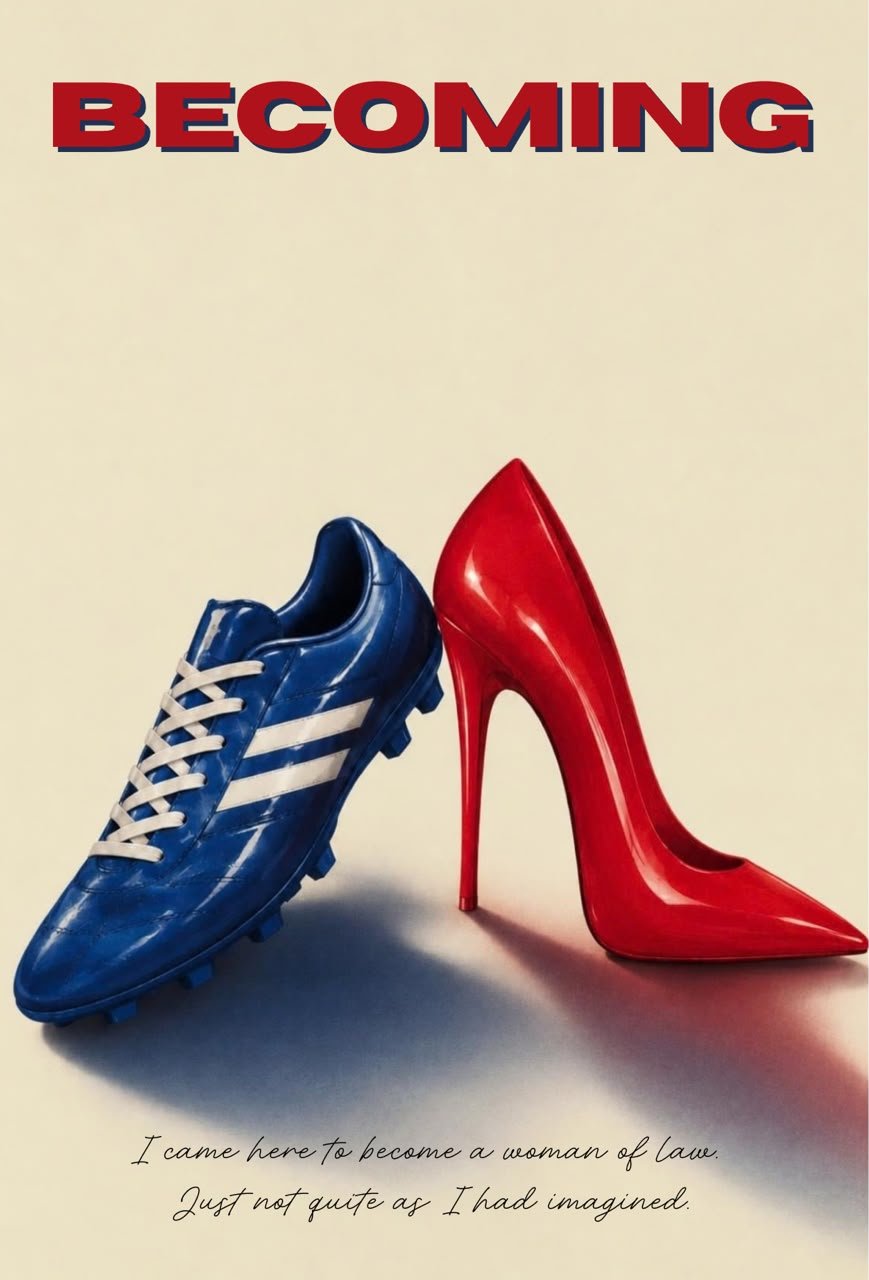
There are worse things to bring to law school than new shoes and an entirely misplaced sense of equality.
I am trying to remember my first day at (J)AIL.
I remember the shoes. I buy too many new ones, which seems absolutely reasonable at the time. I also remember reading The Second Sex, a book so academic that I am not entirely sure what I expect to understand from it. I do not yet have a proper vocabulary for feminism. I barely even have one for being a girl.
I have plans, though. Enough plans to suggest that I am quite prepared to be the “guvnor of my own fiefdom, what what”, blissfully unaware that I have not yet met the people who will be running parts of it.
I come to college bright and smug, with the hopes of becoming. Becoming a woman of law.
My parents come with me to orientation, where they discover that a supposedly co-ed college has a rather generous interpretation of the word “co”.
My mother looks around and loudly whispers, “There are hardly any boys.”
My father surveys the room and sings, “It’s like Kabul has fallen again.”
They laugh, enough to make me look problematic without having opened my mouth.
An Acre of One’s Own
The men do not always enjoy being in the minority. Unless, of course, the minority comes with a debatable abundance of romantic opportunity. And the college, perhaps aiding these interests by keeping everyone sufficiently acquainted, is one acre. One.
These few abysmal acres contain the acad block, the two overcrowded messes, all the many hostels, a sports area, and enough population density to produce an unreasonable amount of gossip.
My own “insufferable womanly jingoism” is apparently second only to one I could have acquired at Jamia, so I have no objection to the acreage itself. It is simply difficult to walk anywhere without being seen.
On an ordinary college morning, right at the gate, five jobless prodigal sons park their Thars and stare at us breathing. When we are fortunate, these sons give way to their fathers in Fortuners. Such is the local food chain, and one can do nothing but admire this occasional upgrade in attention.
The first few days are glorious. I have the best time. I think this is the best place. The college, the city, the roads, the lake.
Then there are the evenings when returning home is Takeshi’s Castle.
I remember half a dozen girls escaping the Wednesday biryani when a brand new Roxx with a VIP plate begins following them across the lengths of an insanely busy road.
The windows roll down. The men inside start cussing, calling them names, making gestures, becoming particularly offended when one of the girls returns their courtesy. Then they begin getting out of the car, trying to get hold of them, and providently enough, a lazy PCR appears exactly in time to halt them (for a few minutes at least). The girls get away, although the car continues trying to follow their cab for some distance, as though harassment becomes a more respectable enterprise if pursued with sufficient determination. Eventually they leave, presumably to continue their “gedi” pilgrimage elsewhere.
There are countless stories like this, some more frightening and some merely exhausting. Students are threatened with assault. Threats and bats turn into guns now. I do not leave college without my pepper spray.
I feel unsafe. My friends feel unsafe. Regardless of what is said, where someone goes, and last of all, what someone wears, there is always the possibility of becoming a target.
Game.
By the time I get back inside, the sun has set on a rather benevolent regime, and I remember the COC.
The college is a definite stalwart of welfare & education, all enforced by an impressive little PDF considering how much importance can be attached to it without necessarily putting everything people suggest into it. There are discussions about things relevant to education and welfare and clothes, about what might be appropriate, about what might be better avoided, about the occasional garment that appears to acquire a surprising amount of significance simply by being worn by a girl.
“Why are you dressed like this?” is a usual manifestation.
There is an explanation. There is some discussion. There is usually a protest, followed by a meeting, followed by a promise to look into the matter, followed by the matter being looked at so thoroughly that nothing happens to it at all.
Then a new batch arrives, and the suggestions return with the persistence of mould. Something about shorts this time, and something about slippers next time. The details change just enough to make each version sound new, while the general enthusiasm for having an opinion about girls’ clothes remains remarkably well-preserved.
The old batches graduate, and the new ones are not yet familiar with the acrobatics. And ever so suddenly, something that has already been discussed, protested against and apparently buried resurfaces with the innocent expression of a “brand new” administrative idea.
How many times before it becomes custom?
More, evidently.
There are also reverse open houses. Where we are called daughters, then summoned to learn the T&Cs of daughterhood in the same breath. Control your behaviour, think about what you wear, watch what you buy. And please, please do not mistake being loved for being supported.
Our purchases are rationed, our choices scrutinised, and the surveillance grows more ambitious by the semester.
“Daughter” I realise, is less a term of endearment than of jurisdiction.
Trivial institutional inconveniences against own students are pursued with admirable urgency, while complaints on possible grievous hurt and criminal intimidation to students appear to require a separate set of checkboxes, preferably ones nobody can tick off.
There is apparently no grievance procedure for grievances about the grievance procedure at all.
And this is an institute of law.
No Time to Die
I have been called a “feminist”, although I am not entirely sure I ever was one. I do not know what it means, except that I simply do not like being told what I cannot do, particularly when the reason appears to be that I am a girl. As a child, I assume equality means being allowed to do the same things. I do not know about first sex, second sex, third sex, or the elaborate taxonomy of being permitted to exist. I think everyone gets to do things until someone tells me otherwise.
Law has now made me notice words. After enough Bare Acts, even ordinary ones start looking a little eerie. Decent, safe, strong, weak, good, bad. And they seem to acquire new meanings rather quickly when the subject is a girl.
Eventually, I go back to my room and start watching movies and shows, because this is what I do after a long day of pretending to study law and looking up five irritating things on Substack.
Then I notice something I cannot unsee.
I rewatch Suits. Jessica runs the firm. I watch Brooklyn Nine-Nine. Santiago is brilliant, irritating and gloriously competent. I watch GOT. Women inherit kingdoms, command armies and manipulate dynasties.
And still I notice how often the story pauses to look at them.
It is not that women cannot be the main protagonists. It is not even that men are not allowed to be attractive. People swoon over, say, Callum Turner all the time, and nobody needs to convene a locker room about it. The difference is, sadly, stranger than that. We can look at a handsome man because we fancy him, while the camera can look at a woman before the story has even decided
what she is there to do. One is us having eyes, the other is cinematography.
This is what Laura Mulvey calls the “male gaze”.
A woman can be the lawyer, the soldier, the queen, the comedian, the villain, the hero. She can move the entire plot along. But she is only scenery with dialogue, still only worth her “to-be-looked-at-ness”.
And this, annoyingly, is what breaks the fourth wall for me.
I read the news now (I try). There are women making the first impossible things look rather ordinary these days. On Monday, Susan Coyle becomes Australia’s first woman Chief of Army. On Tuesday, Sqn Ldr Mohana Singh becomes the first woman to fly the ever so iconic Tejas in a frontline squadron, while her coursemate, Sqn Ldr Bhawana Kanth casually qualifies at TACDE come Wednesday. Then by Friday, Smriti Mandhana is captaining India as though women have always been allowed to take up that much field.
And then, Sydney Sweeney is back also. This time in a sports betting ad, and the sport is there too, somewhere. Because although a woman can command an army, fly fighter jets, captain a country, she is still required to contribute the more traditional athletic skill of being looked at.
“What, like it’s hard?”
For Compliance Purposes Only
Naturally, to then lighten my mood, I spend the evening viewing college sports, where women are still learning how much field they are allowed to take up.
The boys’ matches are crowded. People arrive early, know the players, sledge and cheer. At the girls’ matches, however, the audience is usually only the sports teams, plus whichever one of us has wandered in by accident and is now too embarrassed to leave.
But before that come the auctions.
There are categories A, B and C, and then there is “Girls”, which is not quite a category so much as a requirement.
An automatic category C.
The boys take more than three quarters of the team purse, while the girls, who practise just as hard, get injured just as often and occasionally play rather well, are bought for a dime a dozen, partly because there has to be at least one. A minimum of one girl is mandatory per team. And this minimum, providently enough, also becomes the maximum.
And I wish it were a lie, but the worst part is what happens after all this inexpensive math.
The leagues begin, and the scorekeeper asks the captain for the names.
He gives him the boys’ names.
The girl stands there.
It is okay. He forgot.
She starts scoring and is told to stop shooting.
It is okay. He has a strategy.
The boys miss and someone calls out, “Koi na, badhiya, badhiya.”
The girl scores and suddenly, there is an urgent need to restore order.
It is okay. It is okay.
There must be a reason.
There always is.
The girl runs in the cold at sunrise because the boys cannot get up. She vacates the evenings because the boys want the field, the court.
When she does get to play, she is pushed to the back regardless of how well she plays. The shots are directed at her, and the passes somehow never reach her. She is weak. She cannot take it. Give it to him.
She can fall just as much. She can get up just as much. She can bring home golds. But there remains a peculiar faith that she cannot possibly play as well as the boys do.
She must vacate.
It is the boys’ time. It is their court. It is their field.
Hell, it is their sport.
I do not particularly blame the boys she plays with. Most of them are her friends, some are good teammates. They laugh with her, help her, cheer for her. Nothing here requires them to be cruel. Only that they accept one girl as sufficient, and then congratulate themselves for having made room.
The day runs from breakfast to class, from class to the field, from the field to the court, and eventually into bed, where I fall asleep scrolling (mostly reporting).
And by then, the internet has usually found another way to make the day feel longer. Somewhere in the manos-fear, a man is explaining that women are the reason men are lonely, another man is agreeing that this is why he has not had a girlfriend since 2019, and a third is charging both of them ₹4,999/- only to teach them how to become men women cannot resist.
The next morning, I put on another pair of shoes and walk through the gate, past the same court, the same field, the same acad block, and the same people I have come to know.
Outside the gate, the usual men remain on duty.
I keep walking, and my shoes are simply shoes. The college is simply college. The boys are simply boys.
Eventually, I go back to my room, watch something, scroll a little, and pick up The Second Sex again.
It is still half read.
I have never finished it, though lately, I find the words less unfamiliar than they ought to be.
I turn out the light.
Becoming.
Becoming the second sex.
-In gratitude to the seniors who kept our playing fields level, and in hope for those who will.