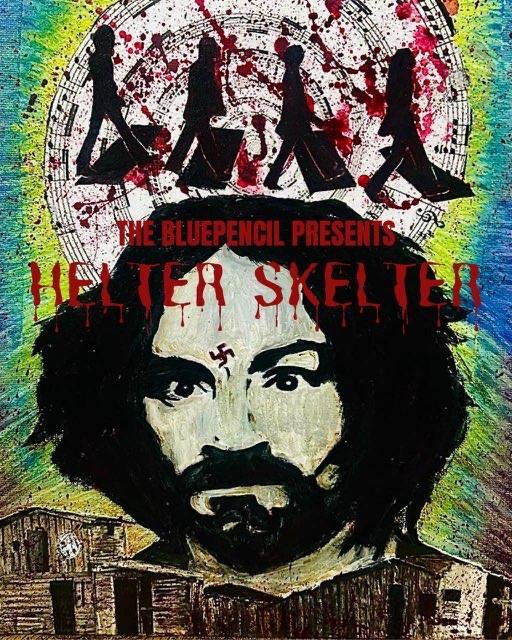
Look down at me and you see a fool,
Look up at me and you see a god,
Look straight at me and you see yourself.
With hypnotizing pitch-black eyes, long hair for horns, and grandeurs of a megalomaniac, Charles Manson, a criminal aspiring to be a musician, went down the halls of infamy screaming, “We’re not in Wonderland anymore, Alice.” He collected strays of bewildered, bewitched, and beguiled followers turned groupies who followed his every word as the gospel truth. For his followers, he was the manifestation of Jesus Christ, their living legend. For the rest of the world, he was the devil disguised as a hippie who wreaked havoc in Los Angeles, the City of Angels, by orchestrating the murders of nine people, including starlet Sharon Tate, for reasons bizarrely wretched and seemingly divine. “You got to realize; you’re the Devil as much as you’re God.”
Son to a 16-year- old runaway who briefly spent time in jail while he was still a toddler, and clueless about his father’s whereabouts, Manson was exposed to an unkind world, which he held against it while living off scraps. Unable to provide for herself, let alone her son, his mother’s circumstances led the courts to destine young Manson for one caged institution to another at the impressionable age of twelve, where reformation was a facade for beatings, torture, and rape. His mother’s lack of attempts to get him out of the hell inside the structure of a religious institution crushed him and his perception of family, leading him to become distrustful and bitter. His heroes became not the glorious Hollywood stars or celebrated sportsmen, but the Al Capones, the Mickey Cohens, and all those who defied the system which had kept him locked in. With this worldview, he survived his dehumanizing conditions equipping himself with necessary life skills and lessons, attempting many escapes, getting kicked around with the blows of the authorities, and what life had in store for him.
With his successful escape at nineteen, the free streets dwelled him with a feeling of alienation as all he had was the education of an outlaw. As a result of this, he became plagued with feelings of inadequacy and inferiority, burning with a desire to prove himself and shift the dynamics. No sooner, he was in and out of prison for petty crimes and thefts. Manson wasted no time in prison and became acquainted with people who had lived and learned from the elusive free streets. He read and reflected extensively about the eye-opening teachings of Buddha, The Gospel of born again Christ, Hinduism’s karmic wheel, gathering an amount of knowledge that made him sound saint-like. His feelings of alienation and desire to be a messiah are reflected in his favorite book Stranger in a Strange land where the protagonist ‘The Man from Mars’ forms an unconventional cult of his own, giving Earth a new education on how to live life in its purest and simplest sense separate from the material world. This vision would eventually be brought to life by Manson after his release. Meanwhile, languishing in prison cells, he had visions of being a musician. Finding a channel of expression and solace in music he sang and wrote his own songs, showcasing a natural musical streak. He had no place or person waiting, nor did he feel like he belonged to the outside world, having spent more than half his life in prison. By the time Manson was about to be released, he had long been comfortable and had accepted prison as his home, giving up on his musical dreams, to the extent that he requested if his stay in prison could be extended. For Manson prison became a frame of thought: We’re all our own prisons, we are each our own wardens, we do our own time. Prison is in your mind. “The mind is endless. You put me in a dark solitary cell, and to you that’s the end, to me it’s the beginning, it’s the universe in there, there’s a world in there, and I’m free.”
Being freshly out of prison in the 60s, Manson suddenly found himself in an eye- opening world of frenzy: children running away from abusive homes, hippies high on peace revolting against the authorities and the traditional norms being rebelled against. Even though quite behind the times, Manson felt right at home. While trying to make an honest living by sleeping on the streets, playing guitars and grubbing outside cafes, experiencing the resentment of people who never failed to remind him where he came from, he encountered many young runaways and neglects from whom he learned to adapt to this new land. There he learned the young might not be so dumb after all and from the young you might even learn.
In the words of Oscar Wilde, “Society must sooner or later return to its lost leader, the cultured and fascinating liar.” With his foot on the ground, Manson began attracting wandering and lost souls, enchanting them with his years of wisdom and empathetic demeanour. What they were deprived of from the world, they found in Manson: a product of the very world they found themselves running away from. It wasn’t just his charming silver tongue and supply of psychedelic goodies that coaxed the young to put blind faith in him. Having been through a troubled childhood himself, this devil had just the tricks up his sleeves. He was acutely aware of the depths of vulnerability and psychology of a wounded person, orphaned from any real possibility of a guiding authority himself. Manson’s followers were believed to be not broken but just the right amount of bruised, and Manson carefully caressed and healed their wounds with ideals of free love, music, and freedom. The number of maidens surrounding him clinging onto his every word, listening to the guide to a more liberated lifestyle based on love and oneness, grew more in number.
Though Manson’s musical dreams were shattered due to disagreements with producers and constant rejection from the mainstream added to Manson’s contempt for the world, yet he continued playing rockstar to his bunch of groupies. The Manson family had made its own lair of iniquity, where they rejected all things materialistic and superficial, and indulged in all things subversive and deemed untraditional. For the world, it represented a den for corrupted souls but for the Manson Family, it was their Garden of Eden. While they believed money can’t buy happiness, it does buy the means for survival in this world. As his followers grew in number, so did the responsibility and arrangements of the naïve young kids without purpose or direction, living off of love and new found possibilities. Honest means of survival were tried and tossed out by Manson, during which he realized that being raised a convict, with no prior education or shared experiences with people around him, he was not equipped for those means. Being antiestablishment and a reject was all the education he had. So he dipped into the dangerous and irretrievable waters of crime which eventually led his ideals of love and freedom into fear and mistrust. Manson then got involved with Gary Hinman, who was later murdered by the Manson family members due to a drug deal gone wrong.
Manson’s image of the New Age prophet came from Vincent Bugliosi, the prosecuting attorney’s explanation of the absurdity and intentions behind the crimes in the famous Manson Family trials. Manson was portrayed as interpreting between the lines of one of the spiritual scriptures of the 60s: The Beatles’ White Album. “Helter Skelter”, also the title of a song from White Album meaning chaos and disorder, was name given to the inevitable apocalypse. McCartney claimed that he was using the symbol of a “helter skelter” as a ride from the top to the bottom, the rise and fall of the Roman Empire. Later, “Helter Skelter”, along with “pig”, “political piggy”, and “war”, was found scrawled on the walls with the victims’ blood. The explanation for the murders that seemed unsolvable was that Manson prepared his family for the apocalyptic Helter Skelter as “the Blacks would soon rise against the Whites.” Amidst all the war, Manson and his family members would be away from all, only amongst themselves.
While he had appreciation for the Beatles, Manson claimed he had no part in this interpretation and his political views were exaggerated and taken out of context. Along with this, his previous connections to the murder of a criminal, with possible association to the Black Panthers, made him paranoid, which in turn motivated some of his more enthusiastic followers into believing his political theories. The whole series of crimes wasn’t racially motivated but was made to appear so to pin the murder of Gary Hinman on Black Panthers, clearing the Mason Family’s name and causing confusion. Having knowledge of these murders and doing nothing to prevent them is all Manson found himself guilty of. “I ate out of your garbage cans to stay out of jail. I wore your second-hand clothes. I have done my best to get along in your world and now you want to kill me, and I look at you, and then I say to myself, you want to kill me? Ha! I’m already dead, have been all my life. I’ve spent twenty-three years in tombs that you built.”
Manson had long ago given up the desire to meet and fit into the restrictions imposed by powers he believed were for nobody’s welfare but those in power. The Bible had driven his mother out of her own home. The people in charge of Manson regularly brutalized him. He often emphasized on how you can’t expect to straighten out an offender’s life when the people in charge of him have worse hang-ups than he does. When Manson asked for the chance to be his own attorney, he was repeatedly denied. He claimed, “I am not the King of the Jews, nor am I a hippie cult leader. I am what you have made me, and the mad dog, devil, killer, fiend, leper is a reflection of your society. Whatever the outcome of this madness that you call a fair trial or Christian justice, you can know this: In my mind’s eye, my thoughts light fires in your cities.”
Manson bore with him the immortalizing weight of the sensational myth he had become, and a concerning reflection of society. While for some, the spell of enchantment had worn off, possibly because legal immunity seemed more appealing, others remain utterly devoted to him still. The letters sent to him in prison demanding his attention, love, and instructions were innumerable. A lot of Charles Manson, Manson himself believed was due to the mythicized version of Charles Manson created and sold by writers capitalizing on the absurdity of the situation, as myths live longer than the truth. The other half of it, Manson blamed on the society for neglecting kids to a level where they turned an ex-convict into Jesus. The flower children’s rebellion in joining him against the world that preached one thing, but failed to provide an example for it, was to him the product of a society that fabricated lies, denied its children, and tried to turn them into a composite of its own hypocrisy. “These children that come at you with knives, they are your children. You taught them. I didn’t teach them. I just tried to help them stand up.”
-This article has been written by Aadya, 4th year.